Every summer we fought dollarweed and nutsedge and nothing from the hardware store touched it. They explained the nutsedge needed a completely different product and why it takes more than one round. Third season now and the yard finally looks right.
Lawn Care Graniteville SC
Mill Town Soil. Horse Creek Moisture.
Graniteville, Vaucluse and Langley sit together along Horse Creek. The valley holds moisture, the old mill-era lots carry disturbed soil, and weed pressure here runs harder than anywhere else in the county.
Graniteville SC sits in the Horse Creek Valley, which holds moisture and drives the county's heaviest dollarweed and nutsedge pressure. Mill-era lots frequently have disturbed or fill soil from the Graniteville Company years. Predominantly Centipede. Year-round weed program is close to mandatory here. Mowing $49–$77/week. Call +1 (839) 746-6007.
Graniteville, Vaucluse & Langley Lawn Conditions
Horse Creek low ground
Lots close to Horse Creek and its tributaries stay measurably wetter than upland Aiken County. That constant moisture is why dollarweed and nutsedge dominate here — both are moisture-indicator weeds and both shrug off standard broadleaf herbicides. Nutsedge specifically requires a sedge-targeted product such as halosulfuron, applied during active growth from June through August, usually across two or three applications six to eight weeks apart.
Mill-era residential grid
The original company housing grid and surrounding older streets. Lots are compact, mature, and frequently sit on disturbed ground from a century-plus of industrial activity nearby. Soil profiles are inconsistent lot to lot — we soil test individually here rather than assuming a neighborhood baseline. Most turf is long-established Centipede.
Horse Creek Valley Road & newer builds
Newer construction along the Horse Creek Valley Road corridor and toward Warrenville. More Bermuda than the old grid, standard subdivision lot sizes, and the usual post-construction compaction issues. These respond well to a first-year aeration and soil amendment before settling into a standard program.
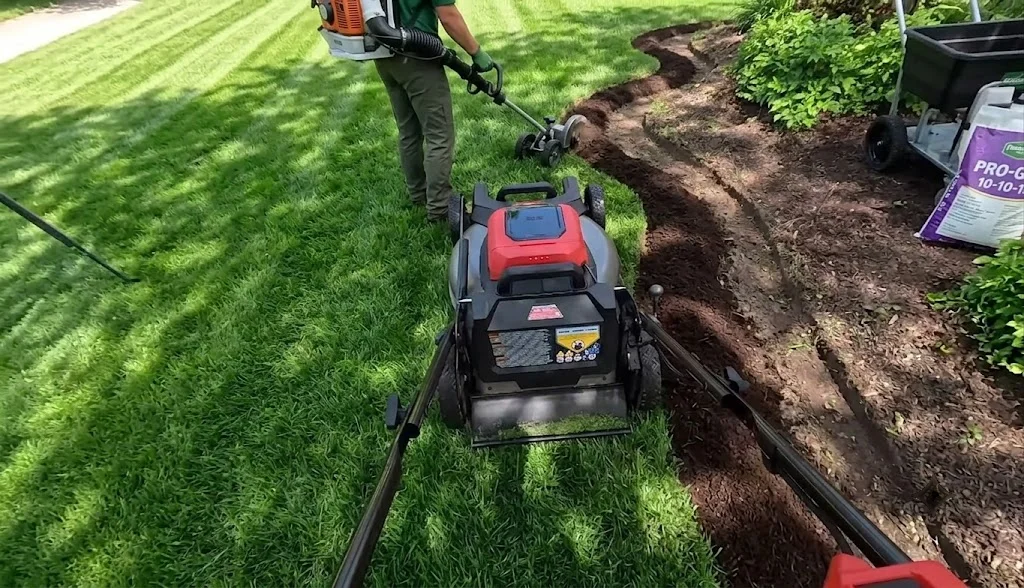
What Graniteville Lawns Deal With
- Dollarweed is the signature weed here. Round, coin-shaped leaves with the stem attached at the center, spreading in consistently moist areas. It signals a drainage or over-irrigation problem as much as a weed problem. Treating it without addressing moisture means it returns every season.
- Nutsedge needs a specific product. The lighter green, faster-growing grass-like weed standing above the turf line is nutsedge, not grass. Standard broadleaf weed killers do nothing to it. It spreads by underground tubers, which is why single applications fail and repeat treatment is necessary.
- Disturbed soil means test, don't assume. Decades of industrial activity in the valley left inconsistent soil across the older residential areas — fill material, altered pH, and variable organic content lot to lot. A soil test costs little and prevents applying lime to a lawn that needs sulfur.
- Valley humidity raises disease pressure. Horse Creek Valley holds humidity longer than upland Aiken, which extends the brown patch and large patch windows. Early-morning-only irrigation matters more here than almost anywhere else we work.
Services Most Requested in Graniteville SC
These are the services Graniteville SC properties call about most, based on the local conditions above.
From a Graniteville Customer

Lawn Care FAQ — Graniteville SC
Why does my Graniteville lawn have so much dollarweed?
Dollarweed thrives in consistently moist soil, and the Horse Creek Valley holds moisture far longer than upland Aiken County. You can identify it by round coin-shaped leaves with the stem attached at the center of the leaf rather than the edge. Because it is a moisture-indicator weed, herbicide alone gives temporary results — it returns each season unless drainage is improved or irrigation is reduced. We typically address both together.
How do I get rid of nutsedge in Graniteville SC?
Nutsedge requires a sedge-specific herbicide containing halosulfuron. Standard broadleaf weed killers have no effect on it at all, which is why homeowners often report treating repeatedly with no result. It grows faster than surrounding turf and stands above the mowing line in a lighter green. Because it spreads by underground tubers, two to three applications six to eight weeks apart during active growth from June through August are normally required.
Is the soil in Graniteville different from the rest of Aiken County?
In the older residential areas, often yes. The Graniteville Company era and the surrounding industrial history left disturbed and fill soil across parts of the original mill grid, and soil profiles can vary significantly from one lot to the next. This is one area where we genuinely recommend a soil test before any fertilization or lime program, because applying lime to a lawn that actually needs sulfur makes the problem worse.
Do you service Vaucluse and Langley as well as Graniteville?
Yes. Vaucluse, Langley and Graniteville form a single cluster along Horse Creek and we service all three on the same routes, so scheduling and crew consistency are identical across them. The lawn conditions are broadly similar throughout the valley — moisture-driven weed pressure, predominantly Centipede turf, and elevated humidity extending the disease window.
Why is disease worse in the Horse Creek Valley?
Valley topography holds humidity longer than the surrounding uplands, which extends the period that grass blades stay wet. Prolonged leaf wetness is the primary driver of both brown patch and large patch. For Graniteville properties we recommend irrigation strictly between 4am and 9am, no evening watering under any circumstances, and annual aeration to improve air movement at the soil surface.
Related Guides & Services
Next steps and related reading for this topic.
Lawn Care Graniteville SC
Local 803 crew. SC-licensed applicators. Free estimates.